
Energy emergency alert trends in PJM underline tight margins operators face in keeping grid reliable
 By Steven Hanson, Energy Technical Writer, External Affairs
Within the PJM footprint, Level 1 and 2 Energy Emergency Alerts (EEAs) have trended upward from 2024 through the first three quarters of 2026, a byproduct of shrinking reliability margins and more frequent extreme weather events.
Reliability Coordinators initiate EEAs during potential or actual energy emergencies when energy deficiencies may result in mitigating activities such as voluntary load shed or operator-controlled load shedding, potentially resulting in electric service disruptions. NERC established EEA notifications to communicate a specific set of emergency conditions among Reliability Coordinators, Balancing Authorities, and Transmission Operators, and the process is defined under Reliability Standard EOP-011 (Emergency Operations) [1].

As part of its oversight activities, ReliabilityFirst (RF) staff continuously monitor grid conditions and review EEA notifications declared by the Reliability Coordinators within its footprint (i.e., MISO and PJM [2]). The number of hours spent in EEA conditions may be considered as a general indicator of grid health [3].
EEA trends
PJM experienced a year-over-year increase in EEA-1 and EEA-2 declarations, as EEA-1s increased from one declaration in 2024 to 11 declarations in 2025, while EEA-2s increased from zero declarations in 2024 to two declarations in 2025 (See Figure 1).
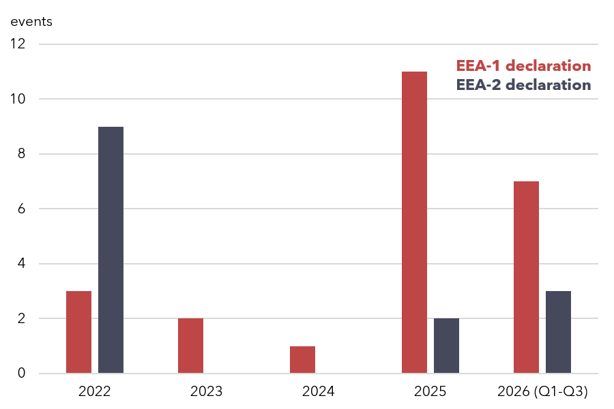
Figure 1. PJM EEA-1 and EEA-2 declarations (2021-2026 Q3)
Source: PJM
EEA-2 declarations through the third quarter of 2026 included three issuances, including two separate declarations on July 2 and July 3 during a heat dome event, and a declaration in mid-September that coincided with a period of planned maintenance and scheduled outages.
The time spent in EEA-1 reached nearly 250 hours in 2025, which was surpassed in the first three quarters of 2026 with approximately 375 hours of EEA-1 conditions (See Figure 2). Events that resulted in EEA-1 declarations included Winter Storm Fern in January, heat domes in July, as well as heat waves in September.
From 2024 through the third quarter of 2026, PJM did not experience any Level 3 EEAs (EEA-3). The Eastern Interconnection accounted for three EEA-3 declarations in both 2024 and 2025, but none of them occurred in PJM, which largely overlaps with the RF footprint. Zooming out further, EEA-3 declarations across the entire U.S. decreased from 21 instances in 2024 to 10 instances in 2025, according to NERC’s 2026 State of Reliability Report. [4] All of the EEA-3 declarations in 2025 occurred on heavy load days that were restricted in generator resource availability and import capability.
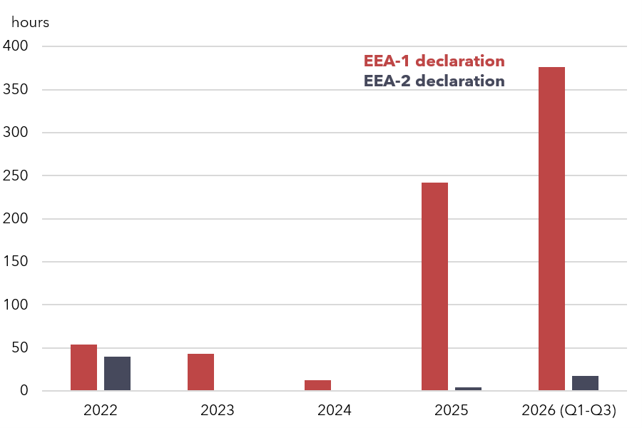
Figure 2. PJM hours spent in EEA-1 and EEA-2 (2021-2026 Q3)
Source: PJM
EEA impact
RF’s August 2025 Baltimore Load Shed Event: After Action Analysis documented the impact of a recent EEA-2 declaration in PJM. [5] On August 11, 2025, a substation outage at Baltimore Gas and Electric Company’s Brandon Shores substation near Baltimore was triggered by multiple failed insulators, which had been contaminated and were susceptible to flashover.
Through a series of escalating emergency procedures, which ultimately included an EEA-2 declaration, PJM followed emergency procedures to initiate demand response, public appeals, and voltage reduction actions. The event resulted in about 20 megawatts of customer load shed, impacting about 4,000 customers over a roughly half-hour period.
When Balancing Authorities experience energy emergency conditions, EOP-011-4 EEA declarations ensure coordination and communication between required entities. In PJM, although EEA-3 conditions with firm load shed have been avoided in recent years, an increase in EEA-1 conditions in 2025 reflects the thinning reliability margins operators face in the control room. During peak demand days and extreme weather events, this can make the electric grid susceptible to energy shortages and electric service disruptions.
Read more about regional resource adequacy concerns in the Grid Transformation section of RF’s 2026 Regional Risk Assessment.
[1] Reliability Standard EOP-011-4 (Emergency Operations) defines the three EEA levels (EEA-1, EEA-2, EEA-3), which do not have to be declared sequentially:
EEA-1: The BA commits all available generation resources to firm load and there is concern about sustaining Contingency Reserves. During EEA-1, non-firm wholesale energy sales are curtailed.
EEA-2: The BA implements Load management procedures (e.g., demand response) to address an energy deficiency. During EEA-2, expected energy requirements are not provided but minimum Contingency Reserve requirements are maintained.
EEA-3: The BA is unable to meet minimum Contingency Reserve requirements and firm load shed is imminent, or in progress. Firm load shed may result in electric service disruptions. EOP-011-4 specifies the communication process for the three levels of emergency conditions between neighboring Reliability Coordinators, Balancing Authorities, Transmission Operators, and other required entities. EEAs do not constitute daily operating practices and are not intended as an alternative to compliance with NERC Reliability Standards. However, EOP-011-4 provides certain requirements that Reliability Coordinators and Balancing Authorities must meet such as providing hourly updates on the RCIS website.
[2] EEAs represent one of PJM’s emergency procedures that is covered in PJM Manual 13: Emergency Operations. PJM issues EEA-1s in conjunction with Maximum Generation Alerts and Load Management Alerts. Prior to declaring EEAs, in order to promote general awareness, PJM may issue a Capacity Advisory up to 3-5 days in advance of an operating day with projected system conditions where tightening capacity may require certain emergency actions such as recalling generation outages.
[3] An increasingly complex operational environment associated with the grid transformation is contributing to energy deficiencies, which is influenced by multiple factors such as reserve margin levels, renewable energy availability, and weather conditions. Large computational loads are an increasingly significant input that may be directed to switch to backup power supplies during energy emergencies. Resource adequacy concerns in PJM may be partly addressed through robust capacity markets and measures to strengthen BPS resiliency during severe hot and cold temperatures.
[4] 2026 NERC State of Reliability Report
[5] ReliabilityFirst August 2025 Baltimore Load Shed Event: After Action Analysis