
July 2026 heat dome events highlight environmental, situational awareness risk factors across RF footprint, including PJM region
 By Steven Hanson, Energy Technical Writer, External Affairs
In July 2026, grid operator resilience was tested as the ReliabilityFirst (RF) region experienced two heat dome weather events with high temperatures that caused summer peaks in electricity demand. During the two events, which occurred on July 1-5 and July 14-17, PJM’s situational awareness activities involved monitoring grid conditions and coordinating with transmission operators and generation facilities to implement emergency procedures that avoided customer blackouts. Overall, the heat dome events underline the importance of environmental factors and situational awareness, which are two of the top seven regional reliability risks highlighted in RF’s forthcoming 2026 Regional Risk Assessment.
Both July heat dome events had elevated daytime high temperatures near, or in excess of, 100 degrees Fahrenheit across the RF footprint. For example, on July 2, daytime high temperatures on the East Coast reached 102 degrees in Baltimore, and 101 degrees in Washington, D.C., and Philadelphia. The second heat dome event saw the highest temperatures in the southeast and western portions of the United States, but most areas in RF’s footprint also experienced temperatures above 90 degrees Fahrenheit (See Figure 1).
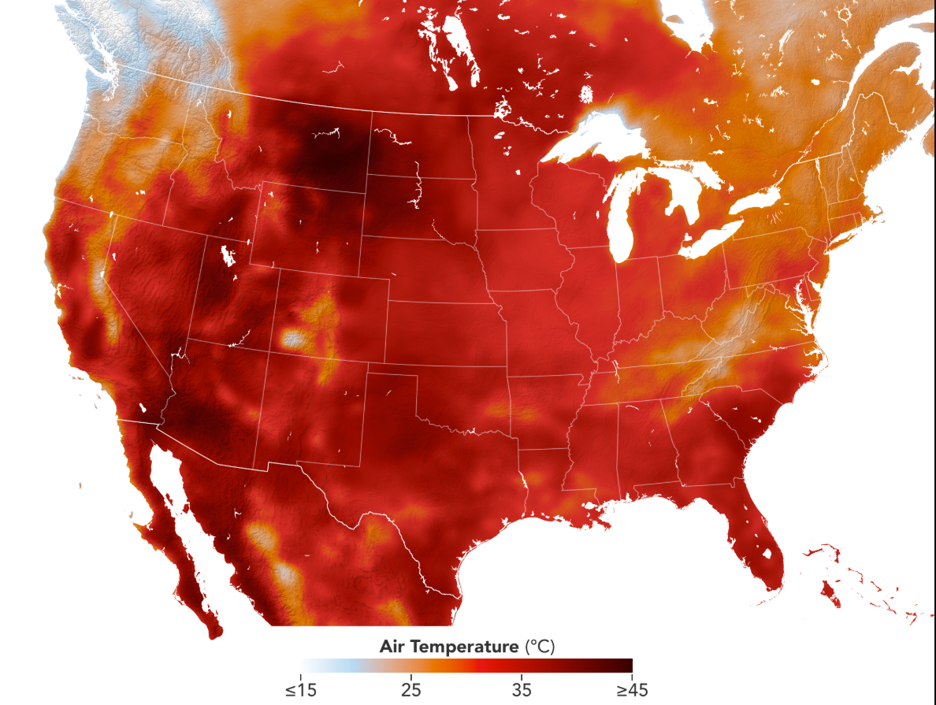
NASA Earth Observatory image of July 14-16, 2026, heat dome air temperatures across the United States
Prior to July 2026, PJM’s all-time summer peak of 165,563 MW occurred on August 2, 2006. Preliminary data indicates that PJM set an all-time record for unrestricted peak load at 168,158 MW from 5-6 p.m., on July 2, 2026. [1] For reference, peak electricity demand during the first heat dome was within 1 GW of PJM’s 90/10 demand forecast value of 169,126 MW, per RF’s 2026 Summer Reliability Assessment. [2] During the second heat dome, preliminary hourly peak load reached 159,021 MW at 5-6 p.m. on July 15, 2026. [3]
Summer peak load events are largely driven by increases in electricity consumption from air conditioners that are used for indoor cooling. PJM’s capacity market is designed to ensure that enough generation resources will be available to meet peak demand levels. In addition, PJM has a number of emergency procedures that it can use during hot weather events to address potential system constraints. [4]
As energy use approached its peak on July 2, some generators tripped offline and forced outages reached 18,100 MW, an outage level higher than the 12,800 MW seasonal outage rate. PJM activated its Pre-Emergency Demand Response, [5] and PJM estimated preliminary demand response performance of about 6,113 MW on July 2. As a result of export curtailments to MISO and other areas, PJM became a net importer of electricity for a period of time on July 3 and July 4. [6]
On June 30, the Department of Energy (DOE) issued two 202(c) orders in response to PJM requests. PJM requested and received approval for an emergency DOE 202(c) order for temporary relief from environmental permit restrictions for generating units, in which PJM estimated usage of approximately 3.25 GW worth of generation from units operating beyond their environmental permit limitations. PJM also requested and received approval for an emergency DOE 202(c) order to direct transmission owners, if required as a last resort to avoid outages for residential and other customers, to curtail supply to data centers and other large loads equipped with backup generation. In response to a PJM request, on July 14, DOE issued a consolidated emergency DOE 202(c) order for July 14-21 that covered both emissions and emergency use of backup generators at large loads during the second heat dome.
In the early-July heat dome, PJM took action to address the hot weather conditions, including emergency procedures that were implemented across PJM and within zones. PJM issued a Maximum Generation Alert and Load Management Alert (NERC EEA1) [10] for July 1-July 3, which was followed up by an Emergency Load Management Reduction Action (NERC EEA2) [11] for July 2-3. During the mid-July heat dome, PJM issued a Maximum Generation Alert (NERC EEA1) for July 15-16, but there was no NERC EEA2 alert.
On the evening of July 2, PJM issued an Emergency Use of Backup Generator Warning as transmission constraints and generation outages posed challenges in the BGE, PEPCO and Dominion transmission zones. This warning, which notifies large load customers of a potential Emergency Use of Backup Generator Action that would require them to be prepared to switch to their backup generation source within 15 minutes, was not exercised during the heat dome event.
Some notable takeaways from the July heat domes include:
• During the early-July heat dome event, preliminary data suggests that PJM set a new all-time record for system peak load on July 2, 2026.
• PJM utilized emergency procedures during both heat dome events, which included Maximum Generation Alert and emergency DOE 202(c) orders. As reserve margins tightened, PJM curtailed certain exports to MISO and other areas.
• The second heat dome event was similar in many ways to the early-July event. However, during the second event, PJM was able to consistently export 6 GW of electricity to MISO, as opposed to the first event that involved a greater amount of curtailments. The second event also coincided with wildfire smoke that seeped from Canada and covered parts of the Midwest and East Coast on July 15-17. Solar plant performance was adversely impacted in areas where the smoke reduced output from solar facilities. At the same time, the smoke reduced cooling load in the mid-Atlantic.
Situational awareness, including real-time monitoring and communications, is an essential component in support of reliable BPS operations during extreme weather events. PJM’s successful performance during the heat dome events was enabled by coordination with electric utilities and neighboring Reliability Coordinators to implement emergency procedures. During both heat domes, effective communication and coordination between PJM and its members played a large role in avoiding any service disruptions experienced by PJM customers. NERC’s 2026 CMEP Implementation Plan recognized the critical importance of effective communications and operating instructions during emergencies where the Reliability Coordinator is responsible for issuing commands to maintain safety and reliability of the BPS. [12]
RF plans to continue its analysis of PJM’s performance during the July 2026 heat dome events to identify any other best practices or lessons learned. RF will provide additional outreach when more information is available.
- See PJM Hot Weather Operations and Load Management Events, July 2-3.
- See ReliabilityFirst Summer Reliability Assessment 2026.
- See PJM July Hot Weather Operations July 14–July 17.
- For example, see PJM Manual 13: Emergency Operations.
- Demand response customers are paid in advance for a commitment to reduce their electricity use during system emergencies.
- PJM June Hot Weather Operations, June 29 – July 5. PJM net schedule interchange(June 29-July 5).
- According to PJM’s Emergency Procedures and Messages Fact Sheet: “PJM issues a NERC EEA Level 1, or EEA-1, in conjunction with a Maximum Generation Alert. NERC defines an EEA-1 as when a grid operator foresees or is experiencing conditions where all available resources are committed to meet electricity load, firm transactions, and reserve commitments, and is concerned about sustaining its required contingency reserves.”
- According to PJM’s Emergency Procedures and Messages Fact Sheet: “A Voltage Reduction Alert and public appeal for electricity conservation falls within a NERC EEA Level 2, or EEA-2. NERC defines an EEA-2 as when a grid operator is no longer able to provide its expected energy requirements, but is still able to maintain minimum contingency reserve requirements. It has also implemented its operating plans to mitigate emergencies, up to but excluding the interruption of electricity service to customers.”
- See 2026 NERC CMEP Implementation Plan, page 12.