
ReliabilityFirst 2025 Misoperation Performance and Improvement Opportunities

By Thomas Teafatiller, Principal Engineer – Protection, Engineering and System Performance
 and Nikitas Zagoras, Principal Engineer – Planning, Engineering and System Performance
ReliabilityFirst is committed to increasing stakeholder awareness of Protection System Misoperation performance, which can increase the severity of events and pose a reliability risk to the Bulk Electric System.
Here’s a high-level look at the current Misoperations risk posture within the ReliabilityFirst (RF) footprint, recent performance trends and our ongoing efforts to monitor and improve performance as risk levels evolve. To read about this topic in-depth, be sure to check out the Misoperations risk profile in our 2026 Regional Risk Assessment as well as our 2025 Misoperation Assessment.
What is a Misoperation?
Protection System Misoperations (“Misoperations”) are defined in the NERC Glossary of Terms as “the failure of a Composite Protection System to operate as intended for protection purposes.” Misoperations include a composite protection system’s failure to operate, delay in operating, or operating when not required during either a fault or non-fault condition. Misoperations contribute to, and tend to exacerbate the impact of, automatic transmission outages, which adversely affect the reliability of the bulk power system (BPS).
Why are Misoperations a risk?
Misoperations can significantly increase the severity of an event beyond what is already being monitored and mitigated in the planning and operational environments. This can lead to unexpected outages that result in reliability issues like thermal overloads, low voltages, and instability that results in loss of customer load. NERC continues to track Protection System Misoperations as a key bulk power system reliability indicator in its annual State of Reliability Report. In addition, RF has identified Misoperations as a medium-high risk in its latest Regional Risk Assessment. In the recent past, this risk has been a concern for RF due to higher than desired Misoperations year-over-year.
The annual Misoperation rate, which is calculated as the percentage of total Misoperations over the total protection system operations, is a metric that can be used to evaluate the performance of protection systems across the Electric Reliability Organization (ERO) Enterprise. The purpose of the Protection System Misoperations metric is to calculate a Misoperations rate and determine the relative performance of all protection systems so industry can identify trends, both positive and negative.
How does RF Misoperation performance compare to its peers?
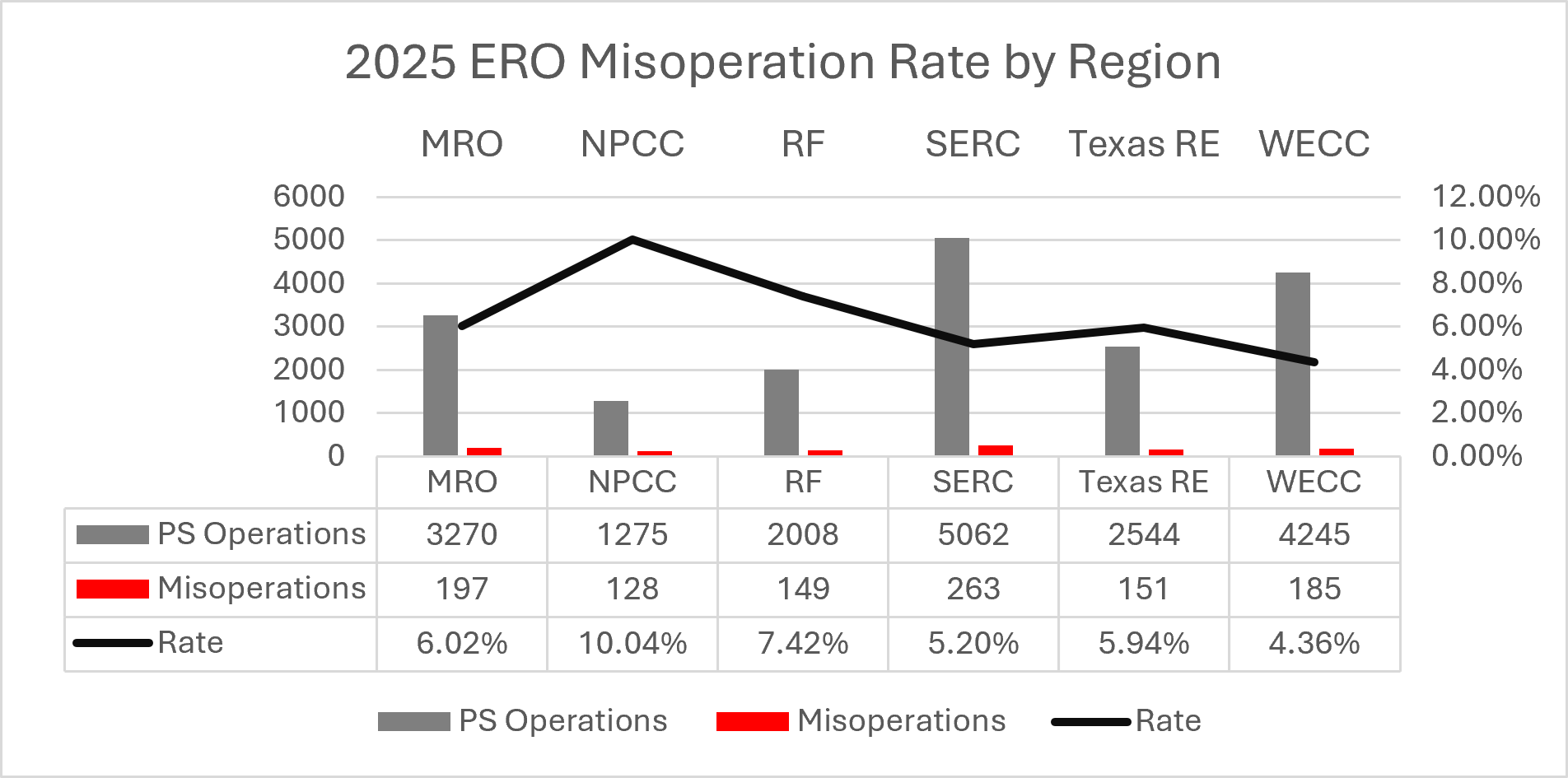
Historically RF has had a higher Misoperation rate than its peers, but since 2020, performance has improved. In 2025, RF’s 7.42% Misoperation rate was just above the 5.83% average rate across the ERO Enterprise.
How has RF’s Misoperation rate been trending in recent years?
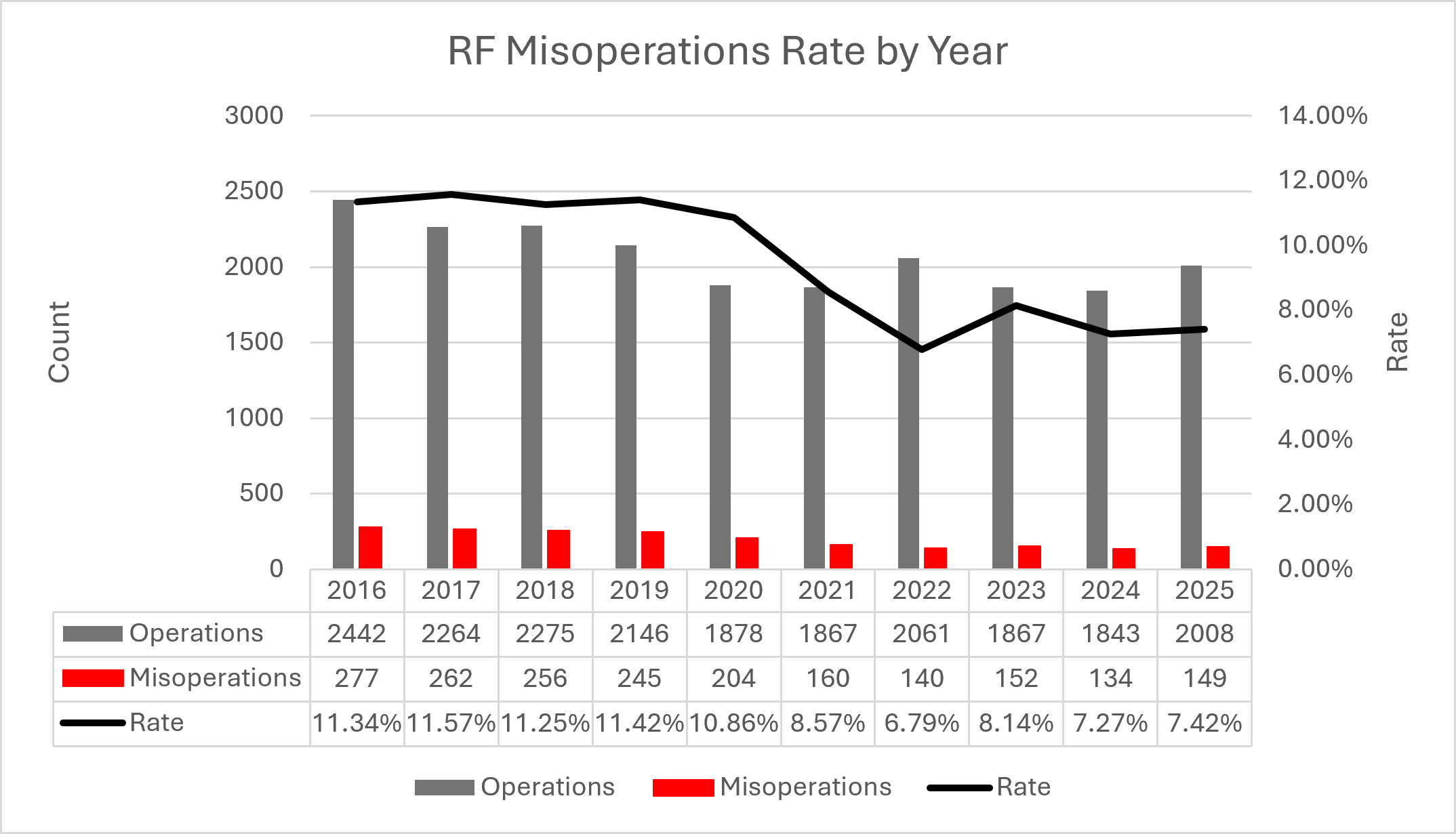
The RF region had a Misoperation rate above 11% from 2016 through 2019. The rate declined to 8.57% in 2021, continued to decrease through 2022, and has remained relatively stable since then.
What causes contributed to Misoperations in the RF region in 2025?
In 2025 there were 149 Misoperations out of a total of 2,008 Protection System Operations in the RF region, resulting in a Misoperation rate of 7.42%.
• The leading causes in 2025 were incorrect settings (34), relay failure (27), AC Systems (25), and as-left errors (16) and communication failures (14).
• Human error accounted for 40% of Misoperations, while equipment failure accounted for 48%. The remaining 12% were classified as other/explainable or unknowns.
• There were four events in the RF footprint with multiple Misoperations.
• Repeat Misoperations also continued to occur in 2025. One facility experienced five Misoperations, another experienced three, and eight facilities experienced two each.
How did RF perform in Misoperations on a quarterly basis for 2025?
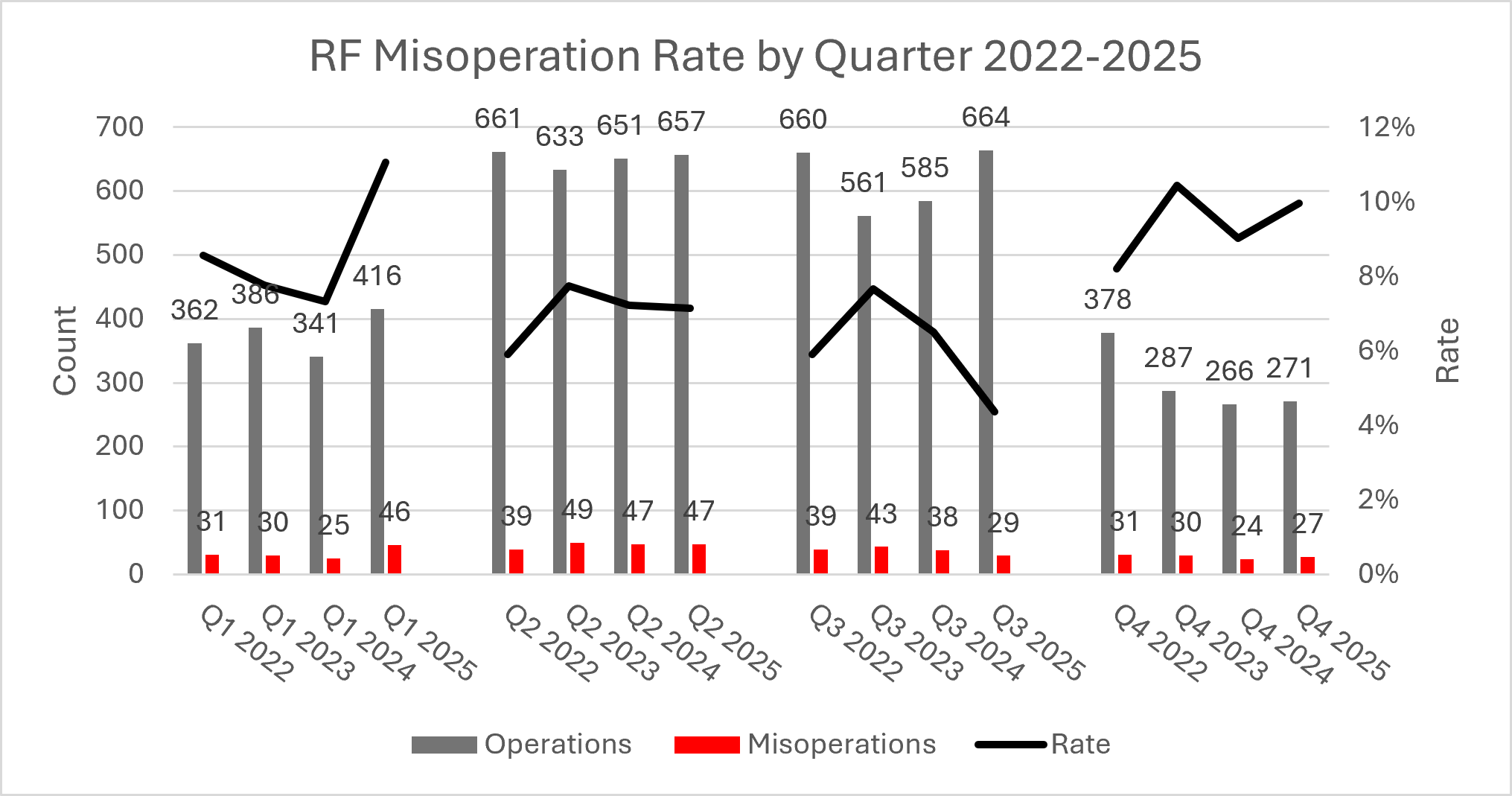
Looking at Misoperations at the quarterly level shows that Q1 and Q4 generally have fewer Protection System Operations, which can result in higher Misoperation rates (shown by the black line) during those quarters. For Q4 specifically, transmission outages are reduced due to a reduction in environmental causes (e.g., lightning and vegetation). Overall, the Misoperation rates across Q1 and Q4 have increased from 2022-2025. In particular, Misoperations for Q1 are exhibiting a notable upward trend in 2025 which drove the overall RF Misoperation rate up.
Is there a difference in Misoperation performance between Generator Owners and Transmission Owners?
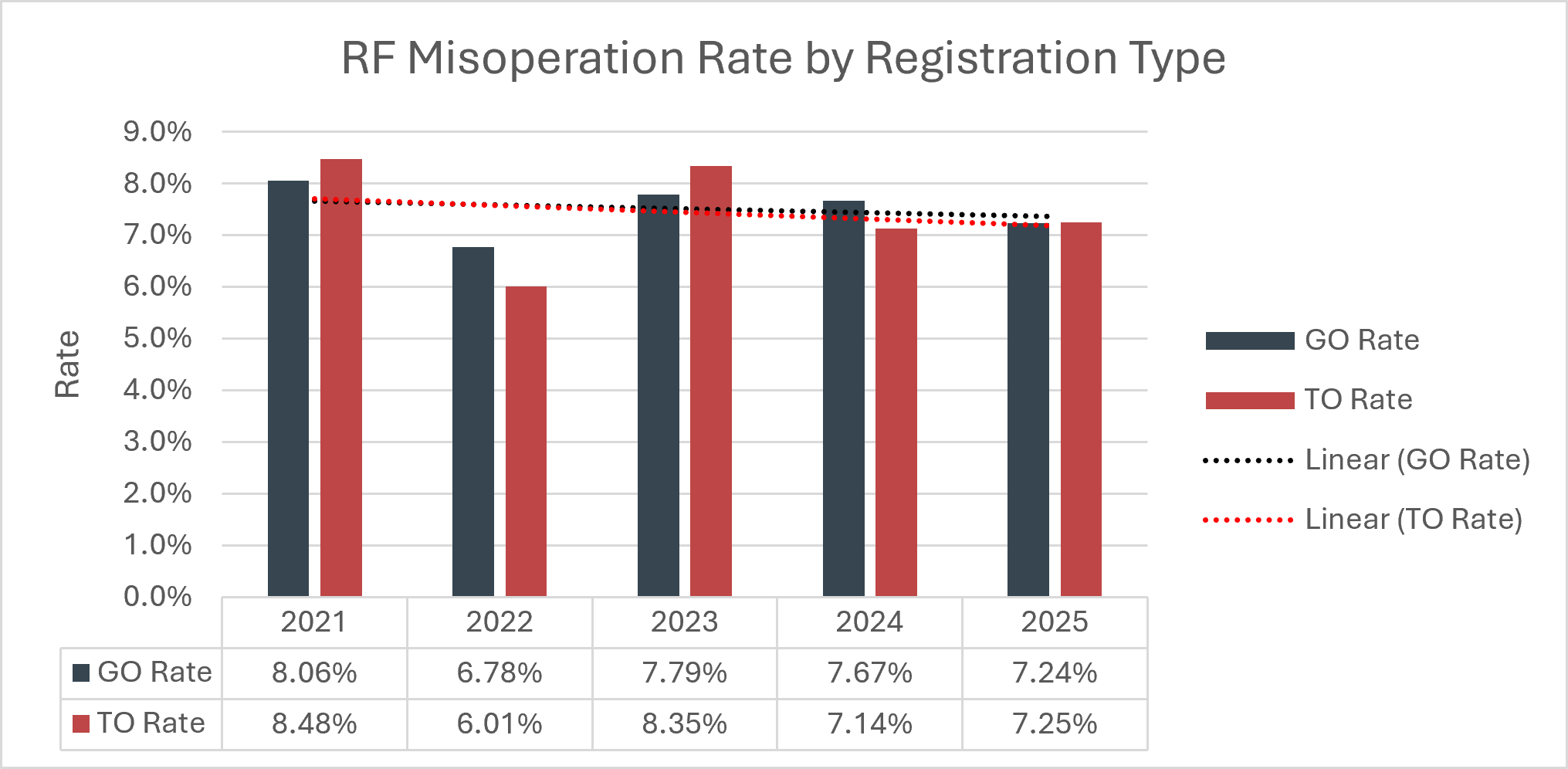
RF also looks at the Misoperations in its footprint for performance differences between Generator Owners and Transmission Owners¹. From 2021 to 2025, both Generator and Transmission Owners have had steady performance improvement with a decrease in annual Misoperations when looking at the linear trendline in the graph below.
During this period, RF has continued its Misoperations outreach, historically focused on Transmission Owners and more recently expanded to include Generation Owners. It should be noted that some of these entities have put in significant time, effort, and resources with targeted implementation plans to effectively improve Misoperation performance.
Another difference between Generator Owners and Transmission Owners is the quantity of operations that Generator Owners have. Due to the physical attributes of a generation plant, operations of protection systems are much less common here than transmission lines that have much more exposure to weather and environmental impacts, which ultimately yields more operations. A single Misoperation at a generation plant has a much bigger impact on its Misoperation rate than it would have for a typical Transmission Owner.
How to get involved and learn more
RF, along with the registered entity members of the Protection Subcommittee, remain vigilant in monitoring risks associated with Misoperations. The Protection Subcommittee brings together protection system engineers to review Misoperations and share lessons learned. If you are a registered entity and would like to participate in the Protection Subcommittee, please feel free to contact Thomas Teafatiller at [email protected] and visit our website to learn more about this subcommittee.
For feedback on this article, including suggestions regarding different risk trend questions to potentially cover in the future, please feel free to contact RF Manager of Engineering & System Performance Johnny Gest at [email protected].
[1] Entities that have a mixed registration of transmission and generation assets are classified as Transmission Owners in this analysis.