
ReliabilityFirst 2024 Misoperation Performance and Improvement Opportunities
 By Thomas Teafatiller, Principal Engineer – Protection, Engineering and System Performance
ReliabilityFirst is committed to increasing stakeholder awareness of Protection System Misoperation performance, as they pose a reliability risk to the Bulk Electric System by increasing the potential severity of an event when they occur.
Here’s a high-level look at the current Misoperations risk posture within the ReliabilityFirst footprint and the ongoing efforts to monitor and improve performance as risk levels evolve. To read about this topic in-depth, be sure to check out our 2025 Misoperation Assessment.

What is a Misoperation?
Protection System Misoperations (“Misoperations”) are defined in the NERC Glossary of Terms as “the failure of a Composite Protection System to operate as intended for protection purposes.” Misoperations include a composite protection system’s failure to operate, delay in operating, or operating when not required during either a fault or non-fault condition. Misoperations contribute to, and tend to exacerbate the impact of, automatic transmission outages, which adversely affect the reliability of the bulk power system (BPS).
Why are Misoperations a risk?
Misoperations can significantly increase the severity of an event beyond what is already being monitored and mitigated in the planning and operational environments. This can lead to unexpected outages that result in reliability issues like thermal overloads, low voltages, and instability that results in loss of customer load. NERC has identified in its State of Reliability Report that Protection System Misoperations are an area of concern to reliability of the Bulk Electric System. In addition, ReliabilityFirst has identified Misoperations as a large risk category in its biennial Regional Risk Assessment. In the recent past, this risk has been a concern for RF due to higher than desired Misoperations year-over-year.
The annual Misoperation rate, which is calculated as the percentage of total Misoperations over the total protection system operations, is a metric that can be used to evaluate the performance of protection systems across the Electric Reliability Organization (ERO) Enterprise. The purpose of the Protection System Misoperations metric is to calculate a Misoperations rate and determine the relative performance of all protection systems so industry can identify trends, both positive and negative.
How does RelaibilityFirst Misoperation performance compare to its peers?
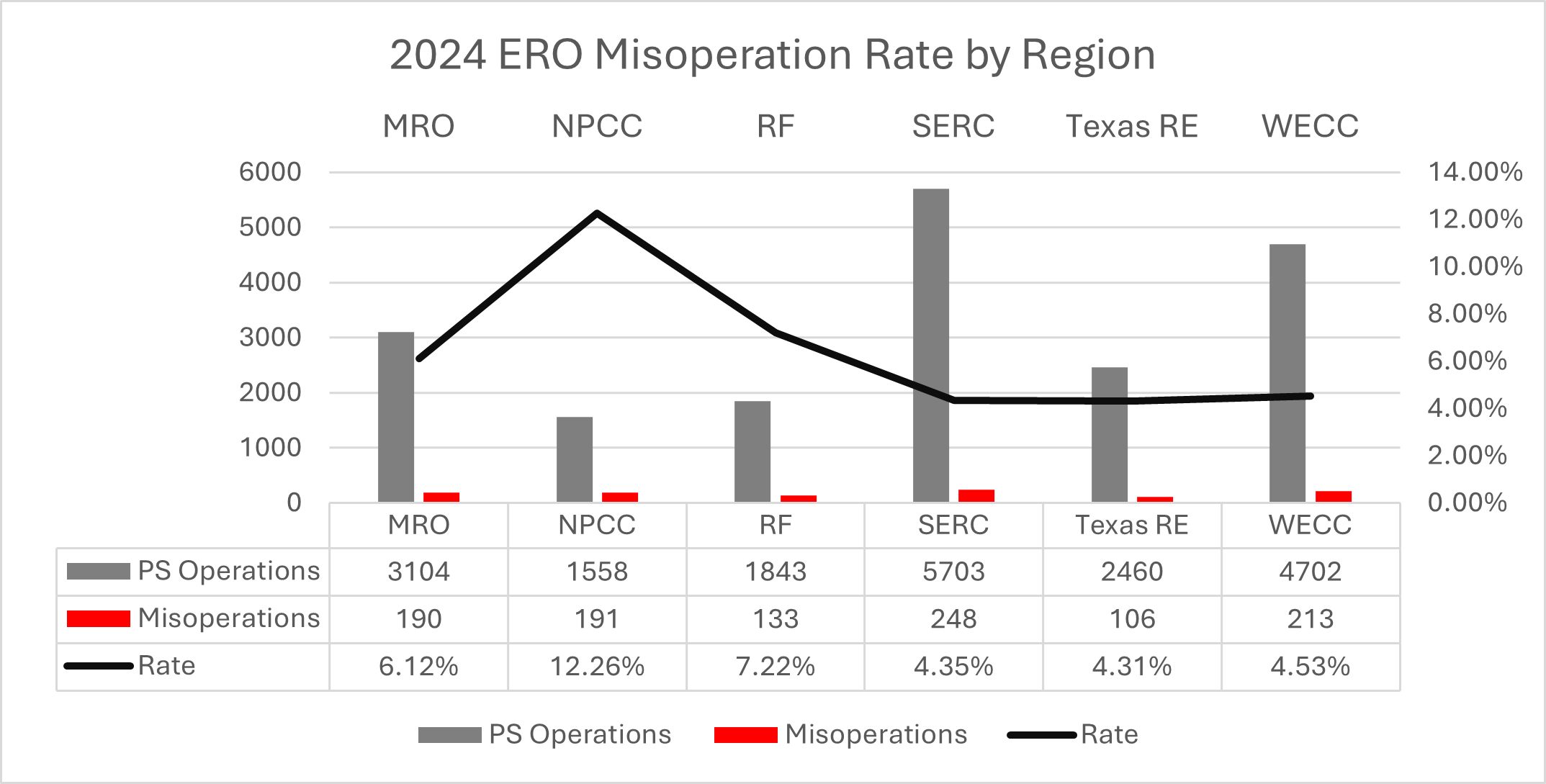
Historically ReliabilityFirst has had a higher Misoperation rate than its peers, but since 2020, performance has improved. In 2024, RF was closer to the average Misoperation rate across the ERO Enterprise.
How has ReliabilityFirst’s Misoperation rate been trending in recent years?
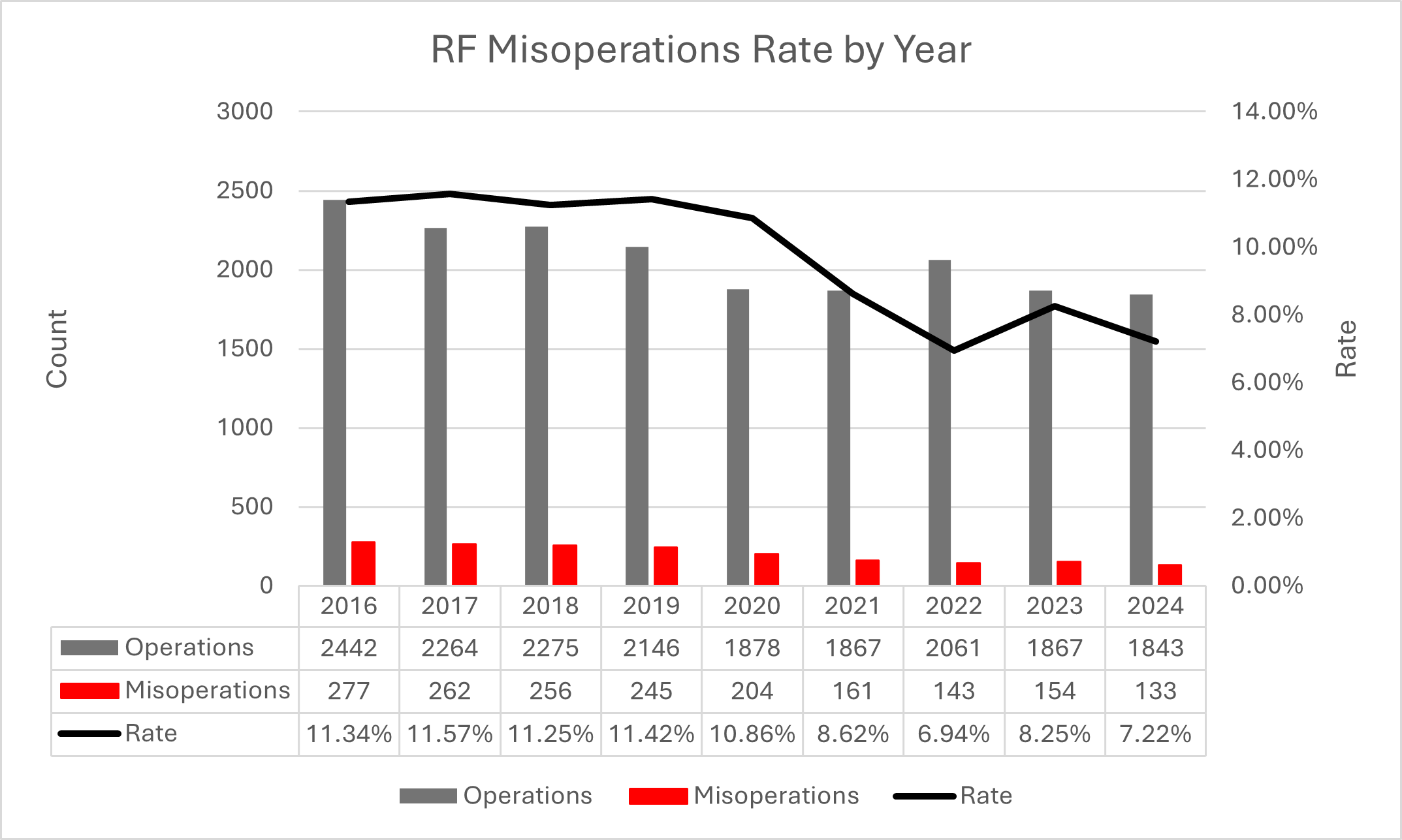
The ReliabilityFirst region had a Misoperation rate above 11% from 2016 through 2019, but this rate fell to 8.62% in 2021 and has continued on a downward trajectory through 2024.
What causes contributed to Misoperations in the RF region in 2024?
In 2024 there were 133 Misoperations out of a total of 1,843 Protection System Operations in the RF region, equaling a Misoperation rate of 7.22%.
• The leading causes in 2024 were relay failure (29), incorrect settings (23), unknowns (15), and as-left errors (15).
• Human error accounted for 39% of the Misoperations compared to 44% of the Misoperations being due to equipment failure, while the remaining 17% were classified as other/explainable or unknowns.
• There were two events in the RF footprint with multiple Misoperations.
• Repeat Misoperations continue to occur. There were two facilities that each had four Misoperations, while another four facilities each had two Misoperations in 2024.
How did ReliabilityFirst perform in Misoperations on a quarterly basis for 2024?
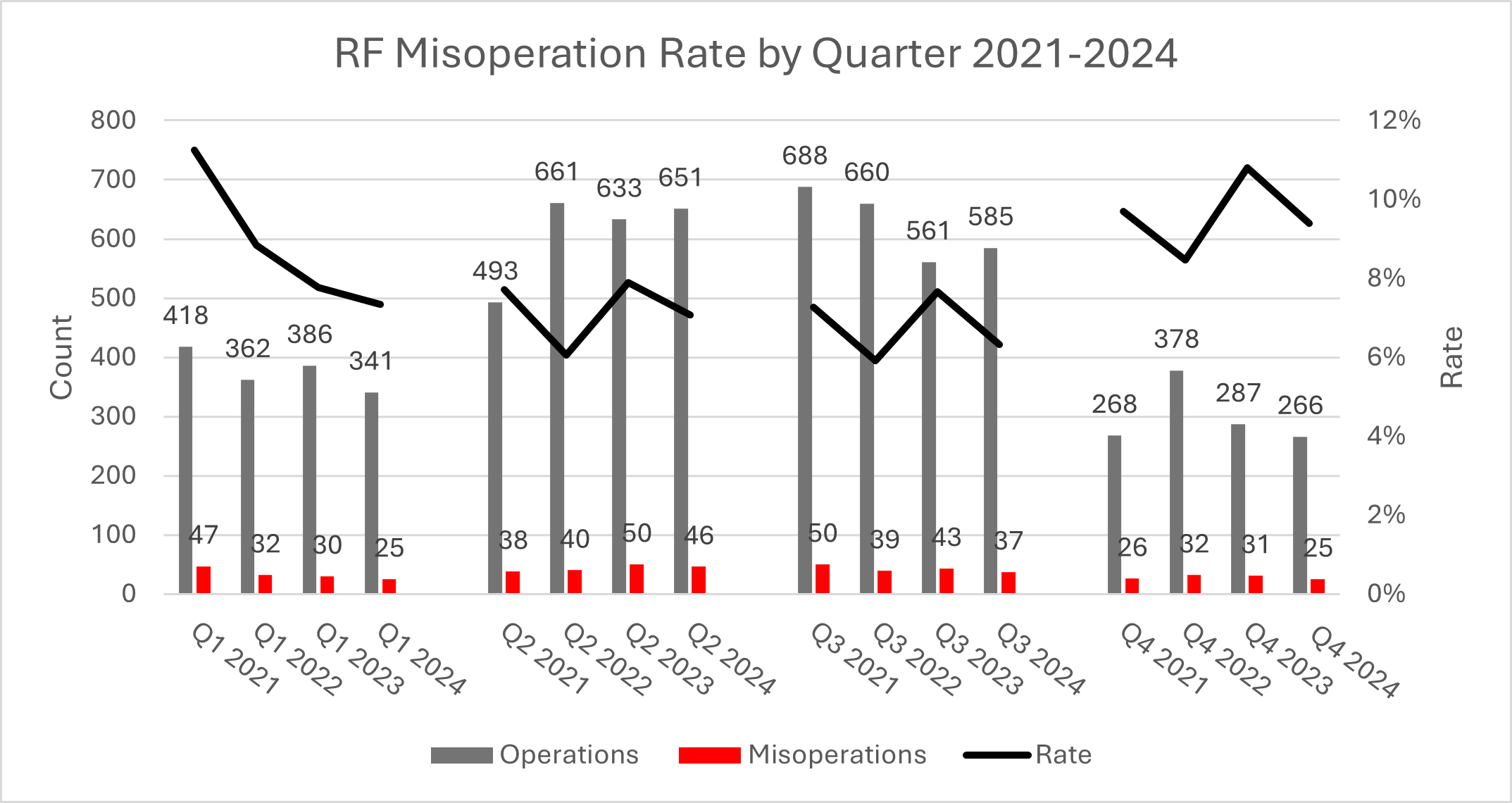
Looking at Misoperations at the quarterly level shows Misoperation rates (shown by the red bar) are higher in the Q1 and Q4 time frames due to lower protection system operations during those quarters. For Q4 specifically, transmission outages are reduced due to a reduction in environmental causes (e.g., lightning and vegetation). Overall, the Misoperation rates across all quarters are on a downward trend. In particular, Misoperations for Q1 are exhibiting a significant downward trend over time.
Is there a difference in Misoperation performance between Generator Owners and Transmission Owners?
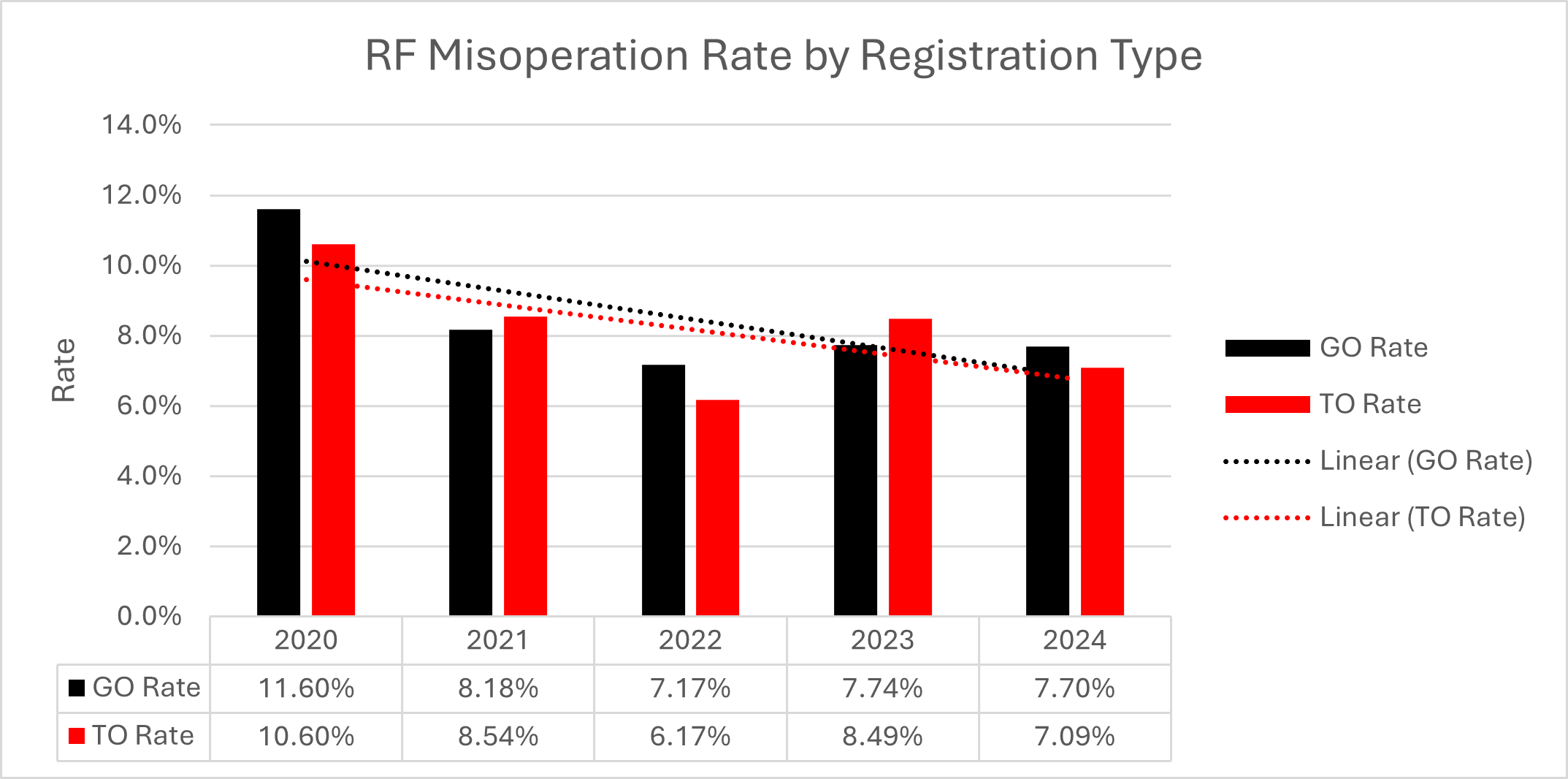
RF also looks at the Misoperations in its footprint for performance differences between Generation Owners and Transmission Owners¹. From 2020 to 2024, both Generator and Transmission Owners have had steady performance improvement with a decrease in annual Misoperations when looking at the linear trendline in the graph below.
These trends may be a result of the historical outreach related to Misoperations performed by RF, which typically involved Transmission Owners, but in recent years has also included Generator Owners. It should be noted that some of these entities have put in significant time, effort, and resources with targeted implementation plans to effectively improve Misoperation performance.
Another difference between Generation Owners and Transmission Owners is the quantity of operations that Generation Owners have. Due to the physical attributes of a generation plant, operations of protection systems are much less common here than transmission lines that have much more exposure to weather and environmental impacts, which ultimately yields more operations. A single Misoperation at a generation plant has a much bigger impact on its Misoperation rate than it would have for a typical Transmission Owner.
How to get involved and learn more
ReliabilityFirst, along with the registered entity members of the Protection Subcommittee, remain vigilant in monitoring risks associated with Misoperations. The Protection Subcommittee membership consists of protection system engineers that diligently review Misoperations and share lessons learned. If you are a registered entity and would like to participate in the Protection Subcommittee, please feel free to contact Thomas Teafatiller at [email protected] and visit our website to learn more about this subcommittee.
For feedback on this article, including suggestions regarding different risk trend questions to potentially cover in the future, please feel free to contact RF Manager of Engineering & System Performance Johnny Gest at [email protected].
- Entities that have a mixed registration of transmission and generation assets are classified as Transmission Owners in this analysis.